


By using our website, you agree to the use of cookies as described in our Cookie Policy
Blog
How to Choose the Right Shower Head: A Contractor's Honest Guide

Deep Dive · Bathroom Remodeling
How to Choose the Right Shower Head: A Contractor's Honest Guide
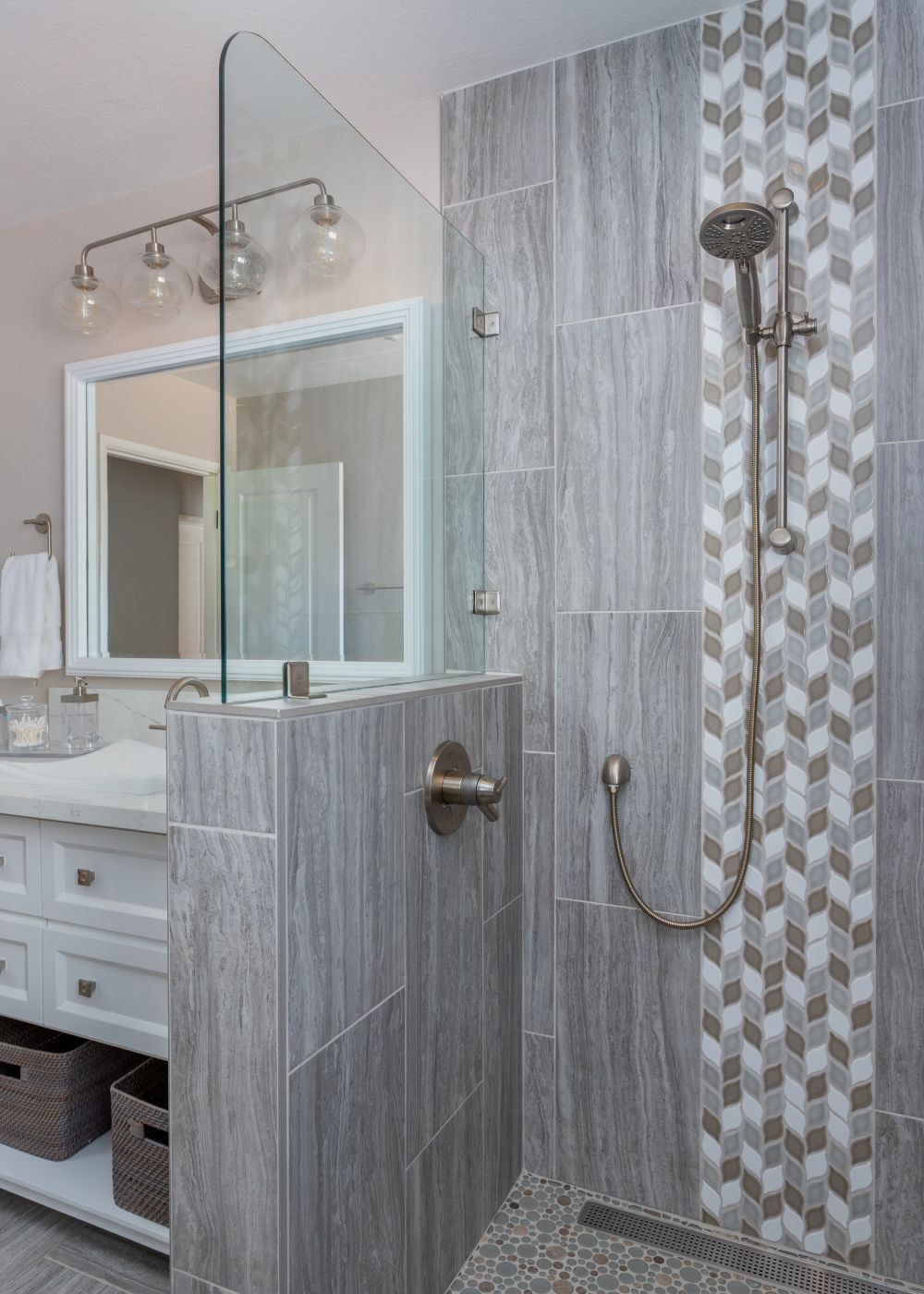
A contemporary bathroom featuring a sleek walk-in shower with a glass partition, gray stone-look tiles, and a vertical accent strip. The design blends modern aesthetics with functionality, creating a clean and elegant space.
We were tiling a master bath in Rossmoor last year when the homeowner came in to check on progress and said, "I already bought the shower head — it's a huge rain head, ceiling mount, I've been dreaming about it for years." She held up the box. Beautiful fixture. We'd seen it in dozens of showrooms.
There was one problem. Her existing plumbing came out of the wall at 6'2". The ceiling was 7'8". A ceiling-mount rain head requires supply lines run through the ceiling — which means opening up drywall, rerouting pipe, patching, retiling. What she thought was a swap-out was actually a $2,000 plumbing job she hadn't planned for.
We made it work, and it looks incredible. But she wished someone had told her that before she bought the fixture. So here's what we wish more homeowners knew before they fall in love with a shower head online.
Start Here: What Affects Your Options
Before you fall in love with a specific fixture, three things will shape what's actually possible in your shower — and two of them have nothing to do with aesthetics.
Your Existing Plumbing Rough-In
The plumbing rough-in is the supply pipe already inside your wall — the one your current shower arm screws into. Its position — how high it is, whether it's in the wall or ceiling, and what direction it faces — determines what you can do without opening up the wall.
Most homes in Walnut Creek and Rossmoor built in the 1960s through 1980s have a standard wall rough-in at around 6 to 6.5 feet. That works perfectly for a traditional wall-mount or handheld combo. It's a harder starting point for ceiling-mount rain heads — not impossible, but it becomes a plumbing project, not just a fixture swap.
Trade Term Explained
Shower arm: The short curved or straight pipe that sticks out of your wall (or ceiling) and connects to the shower head. Most are ½" IPS thread — the universal standard — which means almost any shower head will thread onto your existing arm. The arm itself can be swapped out for a longer or differently angled version without touching the wall plumbing, which gives you some flexibility on height and angle. Rough-in: The supply pipe inside the wall, behind the finished tile. Moving the rough-in means opening the wall.
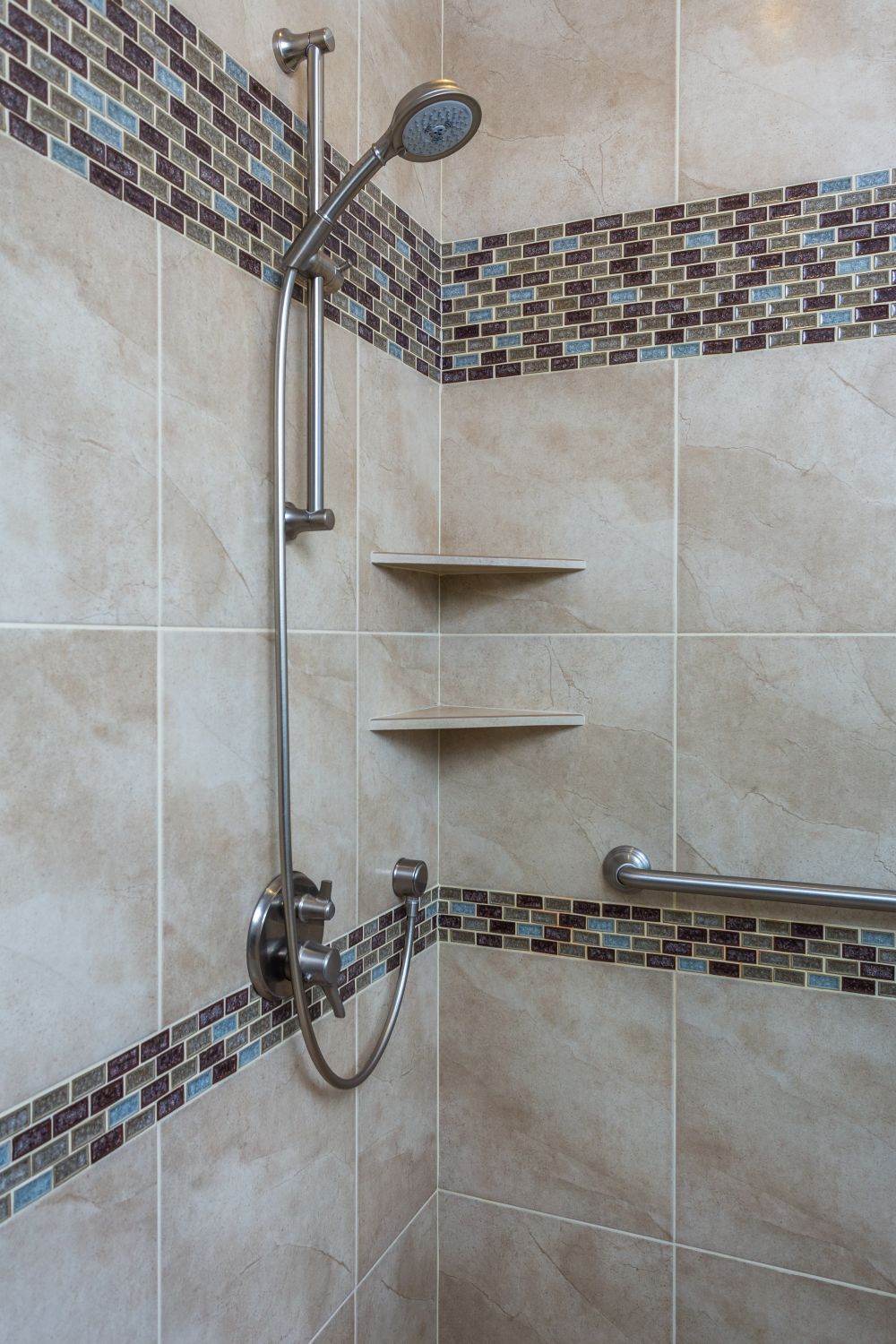
This bathroom showcases a practical shower design with built-in corner shelves and a horizontal accent tile border. The neutral wall tiles paired with detailed trim create a balanced and functional look.
Your Water Pressure
This one surprises people. Rain heads — the big, ceiling-mount or overhead types — need reasonably strong water pressure to feel like rain. With low pressure, they feel like a weak drizzle from very far away. Not relaxing. Just underwhelming.
If you've ever noticed that your current shower feels a little weak, get your water pressure checked before committing to a rain head. Most homes run between 40–80 PSI. Below 45, you'll want a pressure-boosting shower head, not a 12-inch rain disc.
Trade Term Explained
GPM (gallons per minute): The flow rate of a shower head — how much water it uses per minute. California law caps shower heads at 1.8 GPM as of 2018 (stricter than the federal limit of 2.5 GPM). This affects rain heads significantly: a large-diameter rain head at 1.8 GPM may feel sparse compared to what you saw in a hotel in another state, where the rules are different. Look for WaterSense-certified fixtures — they meet the EPA's efficiency standard while still delivering a satisfying shower. PSI (pounds per square inch): Your home's water pressure. Affects how "strong" any shower head feels regardless of its GPM rating.
Your Shower Size
A 12-inch rain head in a 32-inch square shower is going to soak your walls and glass more than your body. Rain heads work best in showers with at least 36 inches of depth — ideally 42 or more. In a smaller Rossmoor bathroom with a standard tub-to-shower conversion, a well-chosen wall-mount or handheld setup will almost always feel better in practice than an oversized rain head crammed into a tight space.
The Four Main Types
Here's what you're actually choosing between — and who each one is genuinely right for.
Fixed Wall-Mount
The reliable classic
Attaches to your existing shower arm. Minimal installation — usually a tool-free swap. Great spray coverage, solid pressure, zero plumbing drama. Often underrated because it's not glamorous. Available in every finish, every price point.
No plumbing workAll budgetsAny shower size
Handheld
The most practical upgrade you can make
Attaches to your existing arm via a bracket, with a hose and removable head. We recommend this for virtually every Rossmoor bathroom remodel. Makes rinsing tile walls easy, bathing easier, and is essential for any aging-in-place setup. Combines with a fixed head via a diverter for a true dual system.
No plumbing workAging in placeBest versatility
Overhead Rain Head
The spa experience — with a catch
Large-diameter head (8–12"+) mounted on an extended arm or ceiling mount. Delivers full-coverage gentle rainfall. Requires good water pressure and adequate shower size to feel right. Wall-arm versions can use your existing rough-in. Ceiling versions require plumbing access — that's a remodel conversation, not a fixture swap.
May need plumbingLarger showersHigher pressure req.
Dual / Combo System
Both worlds, thoughtfully done
A fixed or rain head plus a handheld, controlled by a diverter valve. When planned into a remodel, this is our most recommended setup for primary bathrooms. Gives you the overhead experience for everyday use and the flexibility of handheld for everything else. Requires a diverter valve — plan this during rough-in, not after.
Best planned in remodelPrimary bathrooms
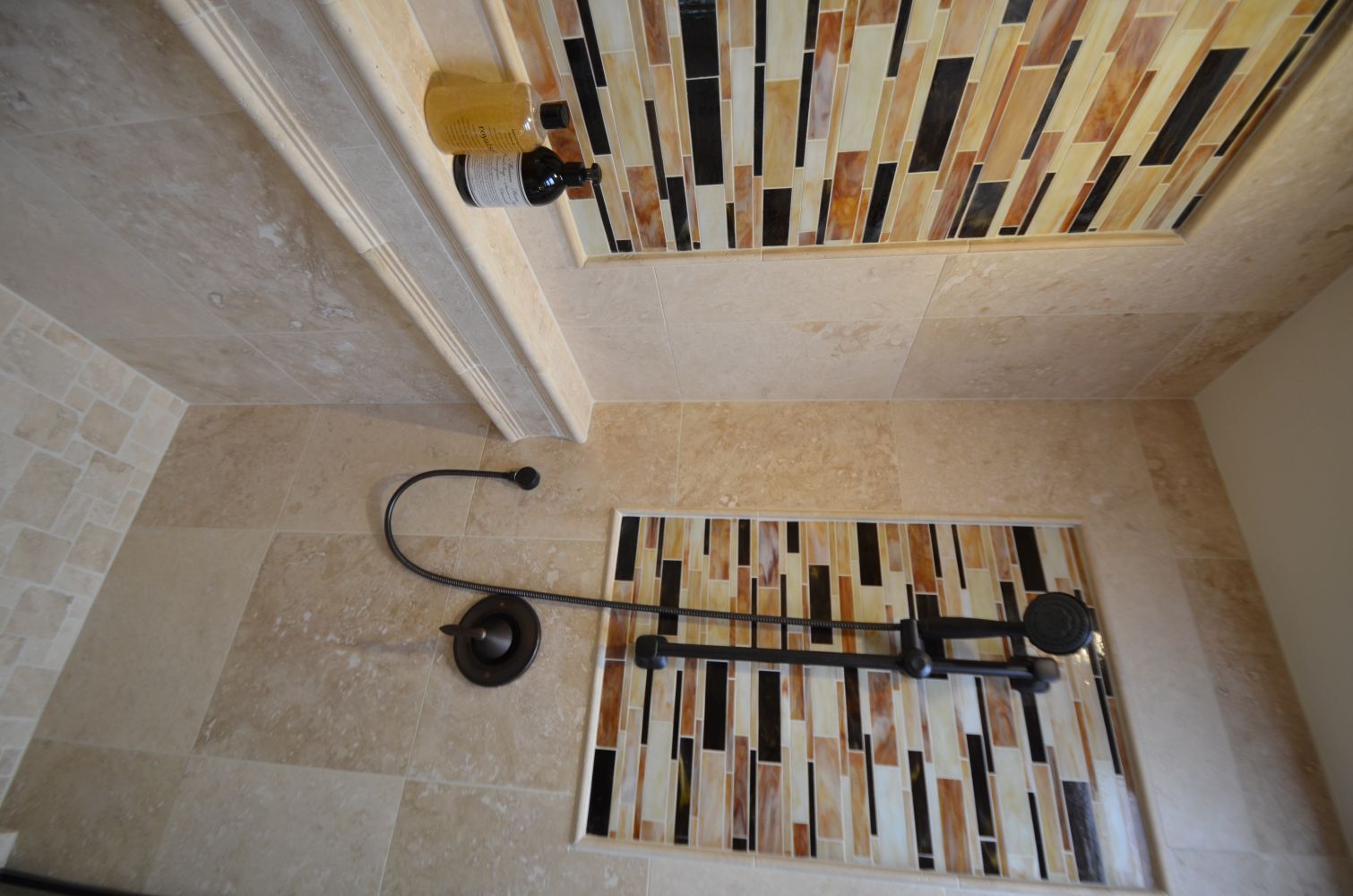
This shower design highlights built-in wall niches with multicolor mosaic tile accents. The combination of neutral tiles and bold inserts adds visual interest while providing practical storage.
What Nobody Tells You About Finishes
The finish you choose matters more than most people expect — not just for looks, but for how much maintenance you're signing yourself up for.
| Finish | Polished Chrome | Brushed Nickel | Matte Black | Oil-Rubbed Bronze |
|---|---|---|---|---|
| Water spots & fingerprints | ✗ Shows everything | ✓ Hides well | ● Shows mineral deposits | ✓ Very forgiving |
| Long-term durability | ✓ Excellent | ✓ Excellent | ● PVD coating varies | ● Can fade/patina |
| Pairs with | Modern, minimalist | Transitional, most styles | Modern, industrial | Traditional, warm tones |
| East Bay water (hard water note) | Needs frequent wiping | ✓ Good choice | White deposits visible | ✓ Good choice |
| Match other fixtures to this? | Yes — exactly | Yes — can vary slightly | Yes — exactly | Yes — exactly |
Trade Term Explained
PVD (Physical Vapor Deposition): A coating process used on matte black and some brushed gold fixtures. It's applied in a vacuum chamber and bonds a thin metal layer to the fixture surface — more durable than traditional lacquer finishes. Good PVD coatings hold up well; cheap ones can chip or discolor within a few years. When shopping matte black, check whether the manufacturer specifies PVD coating and what their warranty covers. Hard water: Water with high mineral content (calcium and magnesium). Walnut Creek and much of the East Bay has moderately hard water, which means mineral deposits will build up on fixture surfaces — especially in the shower. The finish you choose affects how visible that buildup is and how easy it is to wipe off.
One rule we always give clients: match your shower fixture finish to your other bathroom hardware — towel bars, toilet flush handle, faucet. A perfectly chosen shower head in brushed gold next to a chrome towel bar looks like an accident, not a design choice.
When It's Just a Swap — and When It's Not
This is the part of the conversation that most plumbing guides skip, because they're written from the product side, not the contractor side. Here's the honest version.
You Can Swap It Yourself (Usually)
If you're staying with a wall-mount head and your new fixture uses the same standard ½" thread connection — which almost all residential shower heads do — you can swap your shower head yourself in ten minutes. Unscrew the old one, clean the threads, wrap with plumber's tape, screw on the new one. That's it.
You Should Call a Plumber If…
These situations go beyond a DIY swap
- You want a ceiling-mount rain head and your plumbing currently comes out of the wall — the supply line needs to be rerouted.
- You want a dual-head setup with independent controls — that requires a diverter valve behind the wall, not just a surface bracket.
- Your existing shower arm is corroded, stripped, or leaking at the wall — the arm itself needs to be replaced, which often means accessing the pipe behind the tile.
- You're planning a full bathroom remodel anyway — specify the shower head type during the design phase so rough-in can be positioned correctly the first time.
- Your water pressure feels weak and you want a rain head — get the pressure tested first and address the cause, rather than buying a high-pressure shower head and still being disappointed.
"The shower head is the last decision on a bathroom remodel, but it should be one of the first. Where the plumbing rough-in goes is determined long before the tile goes up. Change your mind after the fact and you're opening walls."
A Note on Aging-in-Place Bathrooms
If you're remodeling a Rossmoor bathroom with accessibility in mind — or just thinking about the long game — the handheld shower head is non-negotiable. Not just a nice option. Essential.
A grab bar with a built-in slide bar for the handheld, positioned at the right height, means you can shower comfortably seated or standing. The difference in daily usability is enormous. We design these setups so the hardware looks like a deliberate design choice, not a medical accommodation — because there's no reason it can't be both.
We also consistently recommend pairing a fixed overhead head with a handheld in primary bathrooms. The overhead gives you the full-coverage rinse; the handheld gives you control when you need it. A simple diverter valve — installed during the remodel rough-in — lets you switch between them without replacing anything later.
Trade Term Explained
Slide bar (also called a slide rail or adjustable bar): A vertical bar mounted to the shower wall that holds the handheld shower head at an adjustable height. The head clips into a bracket that slides up and down the bar, so people of different heights — or someone who needs to sit — can position the spray exactly where it's needed. In an aging-in-place bathroom, the slide bar is often paired with a grab bar. When designed well, the two serve double duty: the slide bar is also something to steady yourself on.
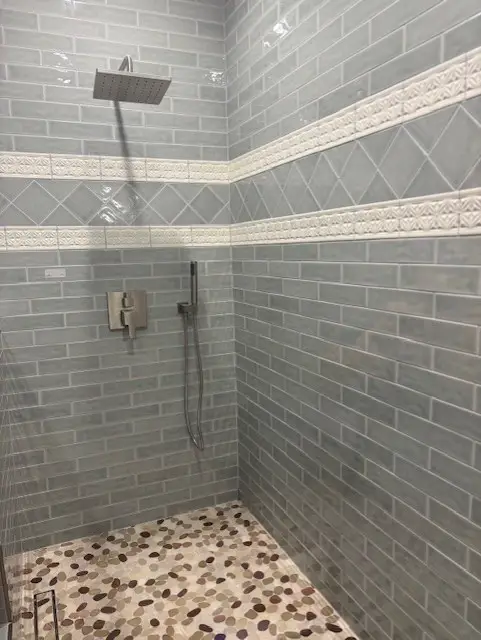
A stylish walk-in shower featuring glossy gray subway tiles, decorative trim, and a pebble stone floor. The combination of textures creates a spa-like, modern bathroom environment.
What We Recommend in East Bay Bathrooms
After 40+ years of bathroom remodels across Walnut Creek, Rossmoor, Alamo, Danville, and Lafayette, here's the honest shortlist of what actually holds up and what clients are happiest with five years later.
Toupin's Practical Shower Head Recommendations
- For most Rossmoor bathrooms: A handheld on a slide bar, paired with a simple fixed head on a diverter. Easy to use for everyone, looks clean, works with the existing plumbing in 95% of units we see.
- For primary bathrooms in larger homes: A dual system — ceiling-mount or extended-arm rain head plus a handheld — planned into the rough-in during the remodel. This is the setup clients rave about years later.
- Finish: Brushed nickel is our most recommended everyday finish for East Bay homes because it hides hard water spots, matches the widest range of tile and vanity hardware, and holds its look over time.
- Brand tier: Mid-range fixtures from Kohler, Moen, or Delta represent the sweet spot — commercial-grade internals, real warranties, parts available if something needs service years from now. We're not against designer fixtures, but skip the no-name imports on anything where the connection point is inside your wall.
- California compliance: Make sure any fixture you buy is labeled WaterSense certified or explicitly rated ≤1.8 GPM. California inspectors will flag noncompliant fixtures on a permitted remodel.
If you're doing a full bathroom remodel — not just swapping a fixture — our bathroom remodeling page walks through the full process. And if you're planning an accessibility-forward bathroom, our post on aging in place remodeling covers the full picture of what goes into a truly smart bathroom design.
Planning a Bathroom Remodel?
We're happy to look at your existing plumbing, talk through fixture options, and help you plan a bathroom that works beautifully for years — not just on install day.
Get a Free Quote Call Us: 925-937-4200
Toupin Construction
Ready to start your remodel?
Whether you're dreaming of a new kitchen, a spa-worthy bathroom, or a whole-home transformation — we’d love to hear about your project. Reach out and let's talk.
‹ Back
Comments